


Clash of Clans
Supercell
I spent time with Clash of Clans as a mobile strategy game, and my first impression was that its appeal comes from decisions that remain meaningful after the initial excitement fades. The basic idea is easy to understand: develop a village, prepare an army, and attack other players. The interesting part is deciding what deserves attention now, what can wait, and how much of my available resources I am willing to risk for a stronger position later.
That long-term rhythm is why this game still feels different from a quick puzzle or a short competitive match. A battle may take only a few minutes, but the consequences of preparation stretch across many sessions. I can improve my defenses, work toward better offensive options, or save resources for a more important upgrade. Every choice closes off another choice temporarily, so progress is not simply a matter of tapping the most expensive improvement whenever it becomes available.
Supercell has built the game for a broad audience, but I would not describe it as completely casual. Its controls are approachable, while its better decisions require patience and observation. The game is free to download, rated Everyone 10+, and available on Android from version 7.0 onward. It also includes optional purchases ranging from $0.29 to $239.99 per item, which is important to keep in mind before treating the experience as a purely relaxed pastime.
Related News

Evony: The King's Return – A Masterclass in Strategy Gaming
Frost & Flame: King of Avalon – A Medieval Strategy Masterpiece

PUBG MOBILE Is Built for Patient, Competitive Players
Where the real decisions begin
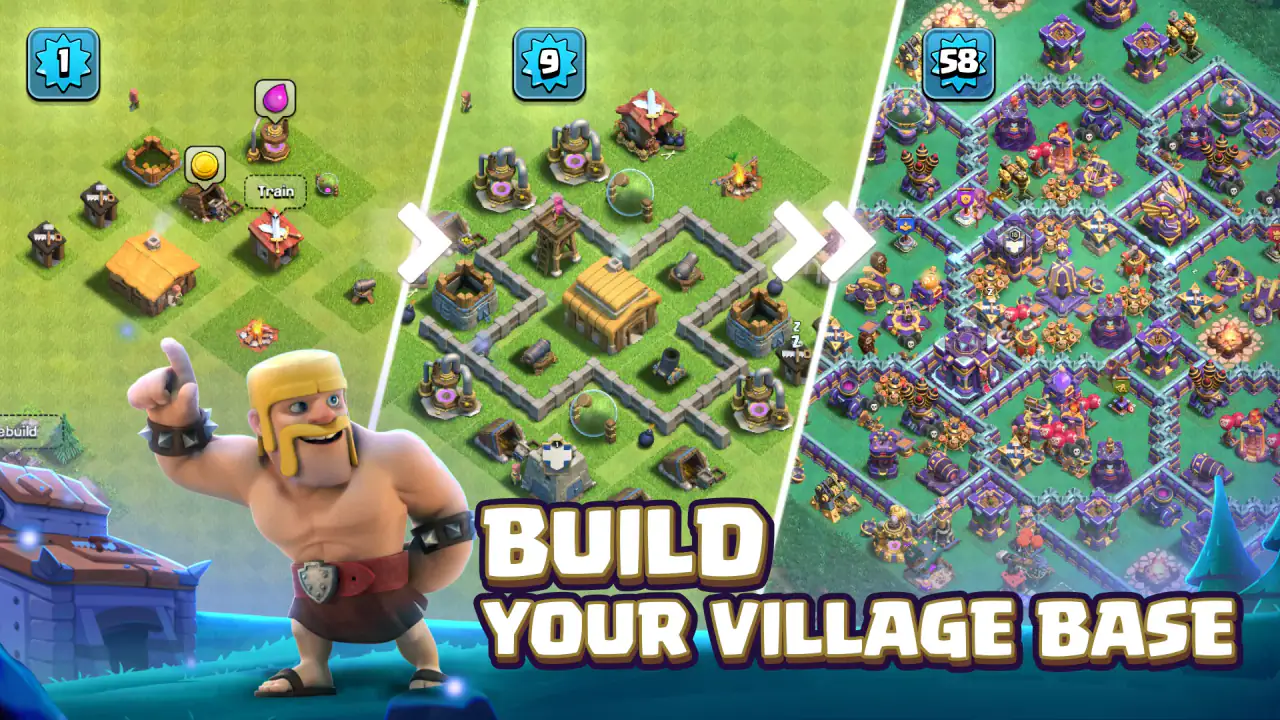
Building a village is an exercise in priorities
When I first looked at my village, it was tempting to improve whatever looked weakest. That approach works for a while, but it soon becomes inefficient. A better habit is to decide what kind of player I want to be during the next stretch of progress. If I expect to attack often, offensive development deserves attention. If I am logging in briefly and want to protect what I have collected, defensive planning becomes more attractive. Neither approach is universally correct; the useful choice depends on how regularly I play.
This is one of the game’s strongest qualities. The village is not just a decorative home screen between battles. It represents a plan. An upgrade can make future attacks easier, but it may also consume resources that could have strengthened another part of the base. I found myself thinking in small horizons: what helps me today, what pays off after several sessions, and what will matter when opponents become more demanding.
Related News

Why WhatsApp Messenger Still Makes Everyday Communication Feel Easy

Jurassic World: The Game Is the Better Dino Tycoon for Strategic Players

Threads in Real Life: Who Should Join, Lurk, or Leave

How SHEIN Turned Shopping Into an Endless Content Feed

How to Make Fortnite Feel Smarter on Mobile

Should You Switch to Microsoft Outlook on Mobile?
That planning also changes how I view an unsuccessful attack. A failed raid is not automatically wasted if it reveals a weakness in my army composition or deployment habits. I can learn whether I committed too many units too early, approached from an exposed side, or ignored a defensive threat. The game rewards that kind of review more than simply repeating the same attack and hoping for a different result.
Attacking is about timing, not just troop strength
The most satisfying battles are the ones where I make several small judgments under pressure. I need to inspect the layout, identify a useful entry point, and decide which units should create an opening before sending in the main force. Dropping everything at once may feel powerful, but it removes my ability to respond when the base behaves differently from what I expected.
I learned to treat an army as a sequence rather than a single wave. Early units can shape the path, later units can exploit it, and support choices matter more when they are saved for the moment they can change the outcome. This does not mean every attack requires a complicated formula. It means that restraint often creates more value than speed. A unit held back for a specific threat can be more useful than one deployed immediately.
Gallery
Another practical lesson is to stop judging an attack only by its final result. I now pay attention to where the plan broke down. If the first group was eliminated before opening a route, the problem may have been the approach rather than the troops themselves. If the army reached the center but lacked enough time or support, the issue may have been delayed deployment. That distinction helps me adjust intelligently instead of changing everything at once.
Base design creates a second layer of strategy
Defending the village is less direct than attacking because I am not present when the opponent makes decisions. My job is to make the route inconvenient, protect valuable areas, and avoid leaving one obvious weakness that an attacker can exploit immediately. A visually impressive layout is not necessarily a practical one. I prefer testing whether the design forces awkward choices rather than assuming that a dense arrangement is automatically safe.
One useful habit is to inspect my own base as if I were trying to defeat it. Where would I begin? Which defenses would I want to neutralize first? Is there a clear path toward the most important structures? This imaginary attack often exposes problems that are invisible when I only look at the village as its owner. Even without changing the entire layout, moving a few elements can make the approach less predictable.
There is a tradeoff here. Concentrating protection around one area may preserve a key objective, but it can leave the rest of the village too easy to clear. Spreading everything evenly can avoid that weakness, yet it may fail to protect what matters most. I enjoy this tension because it gives defensive play its own identity instead of making it a passive waiting room.
Resource management determines the pace of progress
Resources are where the game’s short-term temptation meets its long-term structure. I can spend what I have on an immediate improvement, or I can wait for a more important target. Spending everything as soon as possible feels productive, but it can leave me unable to take advantage of a better opportunity that appears soon afterward.
My most reliable routine is to decide on a destination before collecting aggressively. If I know which improvement I am working toward, battles have a clear purpose. Otherwise, I tend to make scattered purchases and create a village that is slightly better in several areas but noticeably strong in none. This simple change made the progression feel less like maintenance and more like a series of deliberate projects.
Players who dislike waiting should understand this part before committing to the game. Progress is designed around returning over time, and the temptation to accelerate it through purchases is part of the experience. I can enjoy the free path, but I need to accept that patience is not a temporary inconvenience; it is one of the game’s central currencies.
Risk and reward are visible in every attack
Attacking offers a clear reward, but there is always a cost in attention, preparation, and the possibility of a poor result. I have had sessions where an ambitious attack produced a satisfying gain, followed by another attempt that exposed how quickly confidence can turn into carelessness. The game encourages me to push for better outcomes, yet it also punishes attacking without a plan.
I find the best risk decisions happen when I distinguish between a learning attempt and a result-focused attempt. If I am testing a new approach, I can accept that the first outcome may be imperfect. If I need a dependable result, I should use a familiar army and choose a target that fits what I already know how to do. Mixing those goals leads to frustration because I expect experimentation to be as reliable as a practiced strategy.
There is also a social element to risk. A player who attacks constantly may progress through more battles but may also spend more time recovering from poor preparation. Someone who attacks rarely may preserve resources and confidence, but lose opportunities to improve. I prefer a middle ground: regular attacks with a clear objective, followed by a short review instead of immediately queuing another battle out of irritation.
Counterplay makes mistakes useful
What I appreciate most is that many problems have more than one possible response. If a defense repeatedly stops my army, I can change the entry point, alter the order of deployment, or use a different combination of units. If my base is being cleared from one side, I can redesign the route rather than simply adding strength everywhere. This creates counterplay: the answer is often to change the relationship between my choices and the opponent’s setup.
That does not mean every loss is caused by a clever counter. Sometimes the opponent is simply better prepared, or my army is poorly suited to the target. The useful question is whether I lost because of a decision I can improve. If the answer is yes, the defeat has practical value. If I keep blaming the layout, matchmaking, or bad luck without examining my deployment, I miss the part of the game I can actually control.
Adapting without throwing away a working plan
Adaptation in Clash of Clans is not the same as constantly changing everything. In my experience, frequent total redesigns create confusion. I prefer changing one variable at a time: the side of entry, the first group of troops, the timing of support, or the layout of a vulnerable section. That makes it easier to tell whether the adjustment helped.
This approach is especially useful when I am learning. A new army may look impressive, but if I change the army, target selection, and deployment pattern simultaneously, I cannot identify what caused the result. Keeping most of the plan stable gives me a clearer comparison. Over time, small experiments become a personal playbook that I can rely on when I do not want to improvise.
There is a practical reason to avoid copying another player’s strategy without understanding it. A plan developed for one base arrangement may fail against another, and a deployment that works with a certain level of development may not translate directly to my own village. I get more value from studying the logic behind an attack than from memorizing its exact sequence.
Why the game becomes deeper over time
The early hours are mainly about learning the language of the game: what can be upgraded, how attacks unfold, and why placement matters. Later, the challenge shifts toward efficiency. I begin to notice that a small improvement in timing can matter more than a large collection of random upgrades. The game’s depth comes from these accumulated decisions rather than from a single complicated rule.
That gradual development suits players who enjoy building a routine. I can check the village, collect what is ready, choose a target, and set a next step for the following session. The routine is satisfying when I want a game that fits around other activities. It is less satisfying when I want a complete, self-contained match with a definite ending every time I open the app.
The long horizon also changes the meaning of efficiency. A choice that saves a small amount of time once may be less valuable than a decision that improves many future attacks. I try to favor repeatable advantages: a clearer base layout, a more reliable deployment order, and upgrades that support the way I actually play. That is more useful than chasing every possible improvement equally.
Who will enjoy it, and who should skip it
I would recommend the game to someone who likes strategy with visible progression, asynchronous competition, and decisions that carry over from one session to the next. It works particularly well for players who enjoy planning a village, testing attack ideas, and gradually becoming more efficient. The large community is reflected in its average rating of 4.5 from around 62 million ratings, while its install count has passed 500 million, so finding a familiar style of mobile strategy is not difficult.
I would be more cautious recommending it to someone who wants uninterrupted action or a fully even playing field from the first minute. The waiting structure, resource choices, and optional purchases may feel restrictive if immediate access to every possibility is important. Players who dislike revisiting a base repeatedly or who prefer short competitive rounds with no persistent development may find a direct battle game more satisfying.
It is also not the best choice for someone who wants a purely solo experience. Even when I am playing independently, the game’s identity is tied to attacking and defending in a wider player environment. A strategy title focused on campaigns, puzzles, or fixed levels would be a better fit for someone who does not want that ongoing competitive context.
How it compares with other mobile strategy games
Compared with a traditional turn-based strategy game, this one is faster to enter but less suited to long, uninterrupted planning sessions. I am not moving across a large map for hours or managing a campaign with a final victory screen. Instead, I am making compact decisions inside a persistent village. That makes it easier to play in short bursts, although the long-term progression can make a short session feel connected to many previous choices.
Compared with a pure tower-defense game, the focus is broader. Defenses matter, but I am also responsible for preparing attacks, managing development, and learning from other layouts. A tower-defense title may offer more control over a single fixed battlefield, while this game gives me a continuing relationship with my own base. I prefer Clash of Clans when I want my decisions to accumulate, but I would choose tower defense for a more contained challenge.
Compared with quick multiplayer games, the competition here is less about reflexes and more about preparation. I still need to act carefully during an attack, but the result depends heavily on choices made before the battle begins. That makes it a good alternative for players who enjoy competition without needing constant rapid input. It can feel slower for anyone who measures excitement by immediate action.
Practical habits that improved my experience
I stopped beginning every session by spending whatever resources were available. Instead, I choose a target upgrade first, then decide whether the next battle supports that goal. This prevents the village from drifting in several directions and gives even a short visit a clear purpose.
I also started taking a moment before deployment to identify the most dangerous defensive obstacle. That does not guarantee success, but it prevents the common mistake of sending the main force into the easiest-looking route while leaving the real threat untouched. Saving a response for that obstacle is often more valuable than adding another unit at the beginning.
When testing a new plan, I change only one major element. I might keep the same army but attack from another side, or keep the route and change the order of deployment. This makes the result easier to interpret and turns losses into useful information instead of random disappointment.
Finally, I review my own village from the attacker’s perspective after making changes. A layout that looks balanced may still offer a simple path through its most important area. Looking for that path before another player does is one of the most effective uses of a quiet moment between attacks.
My strategy verdict
Clash of Clans remains a strong recommendation for me because it makes ordinary mobile sessions feel connected. I can play briefly, but my choices still contribute to a broader plan. The satisfaction comes from recognizing a weakness, adjusting the design or attack, and seeing the improvement appear over several attempts. Its strategy is not hidden behind complicated controls; it grows from priorities, timing, and willingness to learn.
The limitations are just as clear. Progress asks for patience, competition can expose weak preparation, and optional purchases may appeal strongly when I want to move faster. The game is not ideal for players who want everything immediately or who prefer a match to end completely when they close the app. Those tradeoffs are not minor details; they define the experience.
For me, the best way to approach it is as a long-running strategy project rather than a collection of isolated battles. Set a goal, prepare for it, attack with a reason, and adjust one decision when the result teaches something. If that loop sounds enjoyable, Supercell’s game offers a remarkably durable mobile strategy experience. Its greatest strength is the way small choices become a personal style of play.
FAQs for Clash of Clans
What is the main objective of Clash of Clans?
Clash of Clans is a strategic game where players aim to build and upgrade their own village. The primary objective is to strengthen your base, train armies, and raid other players to earn resources. Success requires balancing offense and defense while joining clans for cooperative battles in clan wars.
Is Clash of Clans free to play, and are there in-app purchases?
Clash of Clans is free to download and play. However, it offers in-app purchases for players who wish to speed up progress or buy exclusive items. These purchases range from small to substantial amounts, so players should manage their spending wisely if they choose to invest in the game.
Can Clash of Clans be played offline?
No, Clash of Clans requires an internet connection to play. The game involves real-time interactions with other players, including raids and clan wars, which necessitate being online. A stable connection ensures smooth gameplay and prevents loss of progress during critical activities.
How does the clan system work in Clash of Clans?
Joining a clan in Clash of Clans allows players to collaborate with others for clan wars and receive support through troop donations. Clans have various levels and perks, enhancing the gameplay experience. Players can join existing clans or create their own, fostering a community environment for strategic battles.
What are the system requirements for Clash of Clans on mobile devices?
Clash of Clans requires a device with at least iOS 10.0 or Android 4.4. The game is optimized for both platforms, offering smooth performance on most modern smartphones and tablets. Ensuring your device meets these requirements is crucial for a seamless gaming experience.
Pros
- Engaging gameplay with strategic depth.
- Regular updates keep content fresh.
- Vibrant community for social interaction.
- Free to play with optional purchases.
- Challenging clan wars boost teamwork.
Cons
- Requires constant internet connection.
- Progression can feel slow at times.
- In-app purchases can be pricey.
- Some updates may introduce bugs.
- Can be time-consuming for casual players.


